fter overtaking Apple in smartphones, Huawei is aiming for No. 1 by 2020

发布时间:2018-11-19 00:00
作者:Ameya360
来源:CNBC
阅读量:2137


Huawei Consumer Business Group's CEO, Richard Yu, attends the launch of the new Huawei P20 smartphone, the new generation smartphones of the Chinese brand Huawei at Le Grand Palais on March 27, 2018 in Paris, France. 

Walk around any major city in China, and you'll see Huawei stores and ads everywhere. That's because it's the number one player in the world's biggest smartphone market, and has become a major contender on the world stage.

The Chinese technology firm overtook Apple to become the world's second-largest smartphone vendor by market share at the end of the second quarter of the year and has set its sights on the number one spot — currently held by Samsung — by 2020.

"Next year, we will be very close to number one, maybe we will be on par with Samsung. And at least the year after, maybe we have a chance (to be number one), the year 2020," Richard Yu, the CEO of Huawei's consumer division, told CNBC in an exclusive interview.

Rapid rise

These days, the company is talking about foldable phones, 5G mobile technology and augmented reality glasses. But it wasn't always like this. In fact, Huawei didn't even have any own-brand smartphones of its own until 2010, three years after Apple debuted the first iPhone.

The company became one of China's biggest technology firms thanks to the growth of mobile networking equipment, and is now one of the largest suppliers in the world for that market. It was also an original design manufacturer (ODM), which meant it designed and made devices for other firms.

In 2010, Huawei launched its first own-brand smartphone called IDEOS running Google's Android mobile operating system and costing around 60 euros ($67.50). Fast forward to 2018 and the company is releasing handsets that have original artificial intelligence chips and world-first features, costing over $1,000.

The move from ODM to smartphone giant was spearheaded by Yu, who previously worked in Huawei's business-to-business (B2B) division and became CEO of the consumer group in 2012. At the time, a few trends got Yu excited about the potential for Huawei in the smartphone space including the switch from feature phones to smartphones and the arrival of 4G mobile internet.

He decided that Huawei would stop making feature phones and focus on high-end smartphones with larger batteries and bigger screens that consumers were asking for.

Clash with the board

Yu has been the face of Huawei's consumer division, often fronting their product launches which have become huge marketing events for the company. He's perhaps unknown outside technology circles but is an outspoken figure.

The CEO says he encourages risk-taking, which has helped Huawei grow quickly.

"I encourage the team to have this innovation capability, to make bold innovations, to do something which some guy feels is a little bit crazy, to challenge ourselves and the industry," Yu told CNBC.

"I am very simple guy. I hate bureaucracy."-Richard Yu, CEO of Huawei's consumer division

Huawei has historically had a business-to-business focus and this often meant Yu clashed with senior management as he tried to push the consumer business.

"The big challenge for me is I'm working for a company, the whole company runs on B2B, our managers, all our guys, executives, are B2B heads, but with this B2B head we are running a B2C business. So there are a lot of arguments, a lot of obstacles because people say, 'you are doing this the wrong way.' Actually we are doing this the right way. This is the biggest barrier," Yu said in a very frank part of the interview.

AI, foldable screens

Still, Huawei has pushed ahead with consumer products. Much of its success so far has been down to putting out smartphones with new technologies but at affordable price points. It has been pushing the barrier with prices and also bringing in cutting-edge features. For example, the P20 Pro was launched earlier this year, boasting a triple-lens camera that retailed for just over $1,000.

Huawei also designs its own artificial intelligence chips which appear in its smartphones, much like Apple does.

For Yu, AI will be a key technology that will take smartphones to the next level and help the company grow in the future.

"AI is coming. AI will be the engine for all the future services. AI will be elementary to working on many devices, it will connect all the apps, you can get all the services from this AI capability. The biggest changes in the next 10 years will be AI-enabled phones capability," Yu told CNBC.

For Huawei, it will be a tough battle, especially if it looks to internationalize any services, given the strength of companies like Spotify and Netflix outside China.

"Currently Huawei is primarily synonymous with being a hardware provider and it may find it needs to get its brand more established in consumer consciousness before it can make the transition to offering services too," Ben Wood, chief of research at CCS Insight, told CNBC by email.

"With so many well-recognized services such as Spotify for music and Netflix for films and TV already established with such a large number of consumers, it is doubly difficult for Huawei to grab share in these areas," he added.

"However, history shows that Huawei can be incredibly tenacious so I would not rule out the company slowly getting consumers outside China to embrace its service over time. That said, it's going to be a long tough journey," Wood said.

Politics and competition

Huawei faces some headwinds in its global ambitions.

The company has been caught up in politics over the past few years with its consumer division being dragged into it as well. In 2012, Huawei was effectively blocked from the U.S. network equipment market after the government cited it as a national security risk that could provide backdoor access to leak sensitive information to China. The company denies this claim.

Huawei CEO Richard Yu gives a press conference to present the new Huawei Balong 5G01, a 3GPP 5G commercial chipset on February 25, 2018 in Barcelona, on the eve of the inauguration of the Mobile World Congress (MWC).

Earlier this year, six top U.S. intelligence officials warned American consumers not to buy Huawei phones.

Yu addressed the tough conditions in the U.S., saying it's not necessary to be in the market in order to grow.

"China and U.S. trade war is creating a higher barrier for us. Because the consumer business is so big, I think we can focus on other market rather than U.S. market," he said.

"The market is so big, we don't need to wait for the U.S. market. Instead we can put more energy on the global market," Yu said, adding that Huawei hopes to return to the U.S. but will "have to be patient."

Beyond politics, Huawei is facing stiff competition in the ever-evolving smartphone market.

Chinese vendors like Xiaomi, Oppo and Vivo are its key rivals, while Samsung won't be dislodged from the number one spot easily.

Samsung Mobile's CEO DJ Koh told CNBC in an interview in September that the company was switching its mid-tier smartphone strategy to bring more innovative features to its lower-priced phones, a move which could help it fend off the threat of Huawei. That strategy was seen with the Galaxy A9, the world's first smartphone with a quad lens rear camera, which was released in October.

And Samsung will not be easy to beat. It has only slipped from the pole position in the smartphone market three times in the last five years, usually just for one quarter, according to data from Counterpoint Research.

Neil Shah, a research director at Counterpoint estimates Huawei would need to shop around 30 million to 40 million more smartphones per quarter to overtake Samsung.

"The markets where Samsung is strong – USA, Europe, India — has to be conquered by Huawei to make this happen," Shah said, adding that India will be tough because of Samsung's manufacturing, distribution and brand, while the U.S. is "out of the question near-to-mid-term."

But Shah said that Samsung could see its shipments dwindle because of fierce competition which could help push Huawei to number one.

Yu's ambitions are bigger than smartphones, however. With new products like its speaker and wearable devices, Yu is aiming to create an ecosystem of smart devices.

"We want to take a leading role in the next ten years to become a whole solution smart life provider," Yu told CNBC.

(备注:文章来源于网络,信息仅供参考,不代表本网站观点,如有侵权请联系删除!)

在线留言询价

相关阅读
Huawei Addresses Tau Scaling Heat Concerns as Kirin 2026 Tests Show ~55% Higher Density but Lower Power
  Huawei is offering new data to support its chip-scaling approach, suggesting that higher transistor density does not necessarily come at the cost of higher power consumption. According to Global Times, a new paper by Huawei semiconductor segment chief He Tingbo on the company’s Tau (τ) Scaling Law presented measurements from the Kirin 2026 chip, with transistor density increasing by about 55% while power consumption fell across several key computing units at comparable performance.  The paper, titled “Huawei’s τ Chip Was Supposed to Melt?” was recently posted by He on ChinaXiv, a preprint platform operated by the Chinese Academy of Sciences, STAR Market Daily notes. The paper addresses concerns that sharply increasing transistor density through folding could raise power density and make chips run hotter. Kirin 2026 measurements, however, showed power consumption falling 66% for the NPU, 58% for the GPU, and 41% for the CPU performance core at the same performance level, STAR Market Daily highlights. The NPU stood out, maintaining 29 TOPS while operating at a 63% lower frequency and reducing voltage from 0.85V to 0.55V, with power density falling 73%.  LogicFolding Reduces Power by Cutting Data Movement  According to the paper, much of a chip’s energy consumption comes from moving data rather than computation itself. As STAR Market Daily indicates, the Kirin chip reduces this burden by cutting data movement, which accounts for more than 80% of the energy consumed by a SoC module.  LogicFolding tackles this by turning long horizontal interconnects into short vertical connections between stacked layers, significantly shortening signal paths and reducing interconnect capacitance and energy consumption, as noted by EE Times China. Measurements show that typical core routing lengths can be reduced by 20%, with some critical paths shortened by as much as 70%. The Kirin 2026 uses a 1.5-micrometer hybrid-bonding pitch and has around 50 million vertical interconnects, 10–15% of which are used for signal transmission.  The paper also points to further scaling in future generations. Kirin 2027 test silicon has already reduced the hybrid-bonding pitch to 1 micrometer, with more than 100 million vertical interconnects. Over the next three years, Huawei plans to further shrink the pitch to 720nm while increasing the number of vertical interconnects to more than 200 million, EE Times China adds.  LogicFolding May Face Key Engineering Challenges  However, folding is not an ultimate solution and will require continued system-level engineering and iteration. He stressed that Tau is a time-scaling law, not an energy-scaling law: if designers use all the time saved to raise frequency, power consumption could instead increase. STAR Market Daily also notes that major engineering challenges remain, including hybrid-bonding pitch, wafer warpage, alignment accuracy, and EDA tool adaptation, with further work needed in these areas over the next three to five years.  The Kirin 2026 is expected to power Huawei’s Mate 90 flagship series and its second-generation tri-fold smartphone, the Mate XT 2, both set to be unveiled in September, as noted by Commercial Times. The Mate 90 opened for pre-orders on August 31 and is expected to be officially unveiled starting September 7.
2026-09-08 15:38 阅读量:247
Huawei Expands Tau Scaling Law V2 Paper, Highlighting LogicFolding Path to Ascend AI Chips in 2030
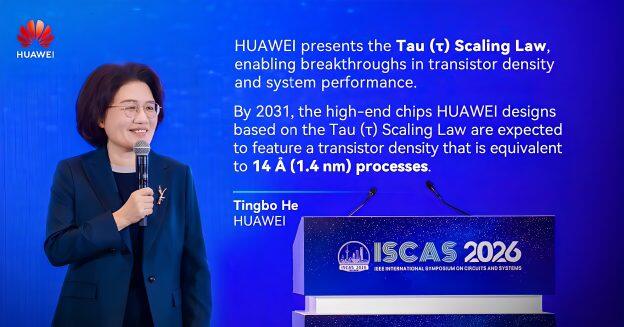
  Two months after Huawei introduced the Tau (τ) Scaling Law in May, the company on July 3 disclosed additional details on an updated version, including further implementation insights and performance-related data. Notably, the V2 version of Time Scaling Theory for Multi-Level Electronic Systems (Tau Law) also outlines a roadmap extending LogicFolding beyond mobile SoCs into AI accelerators, including Huawei’s Ascend 990 expected around 2030.  Kirin 2026 Delivers Density Gain  In the near term, Kirin 2026 serves as the first validation platform for the dual-layer LogicFolding architecture. Chinese media outlets Guacha and mrjjxw.com, citing the paper published on ChinaXiv platform under the Chinese Academy of Sciences, report that compared with the 2025 Kirin 9030 Pro baseline, the Kirin 2026 achieves a transistor density increase from 155 MTr/mm² to 238 MTr/mm², representing a gain of approximately 53.5%.  The paper, cited by Guacha, also notes that achieving a similar gain through conventional geometric scaling would typically require about three years. As reported by Stdaily, Huawei’s first smartphone powered by the Kirin 2026 processor is expected to debut this fall, marking the first real-world test of the technology in the market.  According to Huawei, LogicFolding is a methodology that partitions digital, analog, and memory circuits across vertically stacked active tiers. On a mobile SoC, LogicFolding delivers a 55% stepwise increase in transistor density and a 41% reduction in power consumption at equivalent performance at a fixed device node, the company notes.  (Credit: Huawei)  Guacha further cites the V2 version of Time Scaling Theory for Multi-Level Electronic Systems (Tau Law), which projects logic folding will evolve from localized critical-path optimization to full multi-layer architectures over the next decade, with each package integrating three or more active layers.  The shift, according to the report, is driven by low-temperature hybrid bonding, which relaxes inter-layer thermal constraints, and TSV landing point migration from upper metals to M6, freeing over 30% of routing resources. Under this trajectory, transistor density is projected to scale toward 400 MTr/mm² and beyond between 2026 and 2035, the report suggests.  Next Phase: LogicFolding in Ascend AI Chips  Notably, the V2 version of Time Scaling Theory for Multi-Level Electronic Systems identifies Huawei’s Ascend AI chips as the next application of LogicFolding. According to Guacha, while the technology could enable Kirin processors to boost CPU clock speeds toward 4GHz and beyond, it is also expected to extend to the Ascend 990 AI accelerator around 2030. The report further notes that 3D folding is expected to become the primary carrier of the α architecture through 2035.  According to Huawei, in AI system designs, a co-designed stack—combining memory-semantic Unified Bus fabric, near-package Hi-ONE optical I/O, and edge-to-surface 3D folding—is projected to deliver more than 100× growth in hardware integration by 2035.
2026-07-07 11:18 阅读量:797
Industry Insiders Report Huawei’s Target of Shipping 100 Million Smartphones Next Year
  According to IJIWEI’s report, industry insiders reveal that Huawei has set a goal of shipping 100 million smartphones next year. This target represents a 40% increase over earlier predictions, as various market research firms had previously estimated Huawei’s smartphone shipments for the next year to be around 70 million units.  Huawei’s aggressive sales plan for the upcoming year is propelled by the favorable reception of its recently launched flagship smartphone series, the Mate 60. By the end of this year, Huawei aims to have shipped approximately 20 million units of the Mate 60 series, contributing to the projected annual smartphone shipments ranging between 40 million and 50 million units. This surpasses the previous year’s shipments of 30 million units by 30 to 70%.  With the growing shipment volumes, the supply of Huawei Mate 60 series smartphones featuring organic light-emitting diode (OLED) panels has also seen an increase recently, with suppliers ramping up their production rates.  The Huawei Mate 60 series has become a much-anticipated success in the consumer electronics market. During the Huawei Autumn Full-Scene New Product Launch event, Huawei’s Terminal BG CEO and Chairman of the Intelligent Automotive Solution BU, Richard Yu, expressed his delight with the positive response to the “Pioneer Program” products.  Huawei is currently working around the clock to meet the surging demand for its products. The “Pioneer Program” includes the Mate 60 Pro, Mate 60 Pro+, and the foldable Mate X5.  Several supply chain sources and analysts have indicated that since earlier this year, Huawei has been steadily increasing its stock of components such as lenses, cameras, printed circuit boards, and various other parts to meet its shipment targets. Huawei has also requested that its sole 4G mobile chip supplier in the U.S., Qualcomm, deliver the full-year orders before June.
2023-11-01 16:15 阅读量:3111
Huawei and Xiaomi Announce Global Patent Cross-Licensing Agreement
  On September 13th, Huawei and Xiaomi announced a global patent cross-licensing agreement that covers communication technologies, including 5G.  Huawei stated, “We are pleased to have reached this licensing agreement with Xiaomi. This agreement once again underscores the industry’s recognition of Huawei’s contributions in the field of communication standards and allows us to enhance our future research investment in mobile communication technologies.”  Xiaomi expressed, “We are delighted to have entered into a patent cross-licensing agreement with Huawei, which fully demonstrates the mutual recognition and respect for each other’s intellectual property rights. Xiaomi will continue to uphold its values regarding intellectual property, respecting intellectual property rights, seeking win-win, and building a long-term sustainable intellectual property partnership to promote technology for the benefit of a broader audience.”  Previously, on August 25th, Huawei and Ericsson announced a long-term global patent cross-licensing agreement, covering essential patents related to a wide range of standards, including 3/4/5G cellular technologies within the framework of standards organizations such as 3GPP, ITU, IEEE, IETF, and others. This agreement includes both communication network infrastructure and terminal device sales. According to the agreement, both parties license each other to use their respective standard patent technologies worldwide.  In addition to Xiaomi and Ericsson, Huawei has signed nearly 200 bilateral licensing agreements, and over 350 companies have obtained Huawei patent licenses.  According to official data, as of the end of 2022, Huawei holds over 120,000 valid authorized patents worldwide, with a significant presence in China, Europe, the Americas, Asia-Pacific, the Middle East, and Africa. Huawei holds over 40,000 patents in both China and Europe, as well as more than 22,000 patents in the United States.
2023-09-15 11:25 阅读量:3545
  • 一周热料
  • 紧缺物料秒杀
型号 品牌 询价
CDZVT2R20B ROHM Semiconductor
RB751G-40T2R ROHM Semiconductor
BD71847AMWV-E2 ROHM Semiconductor
MC33074DR2G onsemi
TL431ACLPR Texas Instruments
型号 品牌 抢购
TPS63050YFFR Texas Instruments
BU33JA2MNVX-CTL ROHM Semiconductor
BP3621 ROHM Semiconductor
IPZ40N04S5L4R8ATMA1 Infineon Technologies
STM32F429IGT6 STMicroelectronics
ESR03EZPJ151 ROHM Semiconductor
热门标签
ROHM
Aavid
Averlogic
开发板
SUSUMU
NXP
PCB
传感器
半导体
相关百科
关于我们
AMEYA360微信服务号 AMEYA360微信服务号
AMEYA360商城(www.ameya360.com)上线于2011年,现 有超过3500家优质供应商,收录600万种产品型号数据,100 多万种元器件库存可供选购,产品覆盖MCU+存储器+电源芯 片+IGBT+MOS管+运放+射频蓝牙+传感器+电阻电容电感+ 连接器等多个领域,平台主营业务涵盖电子元器件现货销售、 BOM配单及提供产品配套资料等,为广大客户提供一站式购 销服务。

请输入下方图片中的验证码:

验证码